 AnalyticsCLI.com
 Why Founders Need an AI Growth Engineer
A practical way to turn scattered SaaS signals into focused product work for your coding agent.
AnalyticsCLI Team
May 6, 2026
SaaS founders rarely suffer from zero data.
They suffer from partial attention.
You check activation when something feels off. You look at churn when revenue hurts. You scan feedback when a customer complains. You inspect code when you finally decide to fix something. The hard part is connecting those signals every week without turning yourself into a full-time analyst.
The AI Growth Engineer exists for that operating gap. It uses AnalyticsCLI and connected production signals to answer a practical question:
What is the highest-leverage product or growth task we should give our coding agent next?
The Founder Workflow Today
A typical SaaS founder workflow looks like this:
- check dashboard charts between calls
- remember a customer complaint from last week
- notice signup quality changed after a pricing tweak
- open GitHub and wonder which flow is related
- ask an AI coding agent for ideas
- get a generic list because the agent cannot see the product data
The agent is not the main problem. The input is.
If the agent does not know activation rate, trial behavior, checkout failures, feedback themes, and code surfaces, it cannot rank product work well. It can only guess.
What The AI Growth Engineer Adds
The AI Growth Engineer is designed to connect the evidence before asking for implementation.
It can use signals such as:
- AnalyticsCLI events and funnels
- billing or subscription summaries
- Sentry-compatible crash and performance data
- product feedback
- GitHub code context
- marketing or positioning notes you provide
The point is not to create another report. The point is to create work.
A Concrete SaaS Example
Suppose a B2B SaaS product sees strong signup volume but weak activation.
Manual analysis might reveal one of these:
- users import data but never finish setup
- the empty state is unclear
- the first dashboard looks broken until events arrive
- trial users do not understand the value fast enough
- a new release introduced a confusing permission step
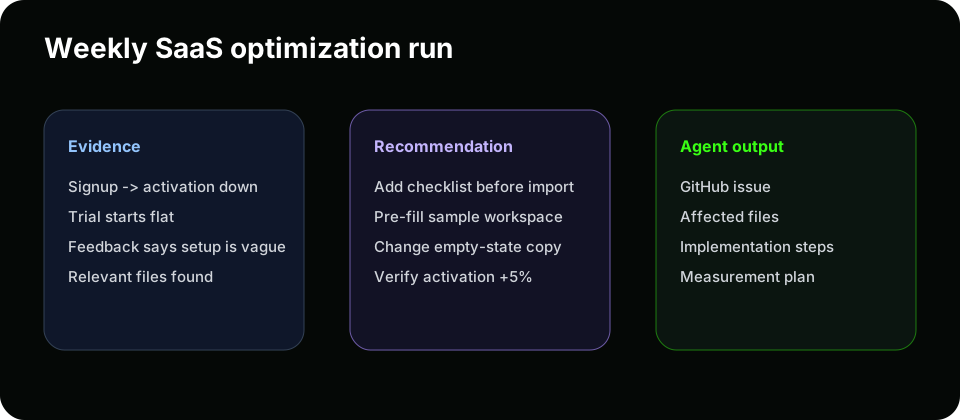
The AI Growth Engineer should not just say “improve onboarding.” A useful output would look more like this:
Activation dropped from signup to first successful import. Feedback mentions setup confusion. No major crash spike is visible. The likely code surfaces are the import wizard and dashboard empty state. Create a task to add a guided sample workspace and rewrite the empty-state CTA. Verify activation rate and first-query completion in the next release.
That is the difference between advice and an implementation-ready handoff.
Why This Is Different From A Dashboard
Dashboards help humans inspect data. They do not automatically translate signals into code work.
AnalyticsCLI keeps the dashboard useful for humans, but adds a CLI and agent-readable layer for workflows. That matters because most founders already pay for an AI coding tool. The missing piece is giving that tool the right production context.
When the agent can see product evidence, your existing subscription becomes more useful:
- Codex can work from a better issue brief.
- OpenClaw can run a recurring growth workflow.
- Claude Code or Cursor can implement with clearer success criteria.
- Your team can review a concrete task instead of a vague idea.
Marketing Advice Belongs In The Same Loop
Product data is not only for code.
If users who complete one setup action retain much better, that is a marketing angle. If reviews repeatedly mention one benefit, that belongs in landing page copy. If trial users churn after a specific expectation mismatch, that might be a positioning problem rather than an engineering task.
The AI Growth Engineer can help draft marketing advice from the same evidence, as long as the output stays grounded:
- audience segment
- product behavior that supports the claim
- suggested landing page copy
- campaign hypothesis
- metric to verify
Guardrails For Founders
Do not let the agent create broad product roadmaps from weak data. Start with narrow loops.
Good first workflows:
- weekly activation review
- trial conversion review
- crash impact review
- feedback-to-issue triage
- marketing angle review from retention and reviews
Bad first workflows:
- “redesign the whole product”
- “automatically ship every suggested PR”
- “change pricing because one metric moved”
The fastest path is usually one issue, one measurable change, one release.
Where To Start
If you are building a SaaS, start by identifying the first moment where a user experiences value. Track that path. Then connect the signals the agent needs to understand what blocks it.
Useful next pages:
The goal is not to replace your judgment. It is to make your judgment less dependent on scattered dashboards and memory.