 AnalyticsCLI.com
 Turn Analytics Into Issues
A simple format for converting product evidence into GitHub issues your coding agent can actually ship.
AnalyticsCLI Team
May 4, 2026
An analytics finding is not product work yet.
“Users drop after onboarding step two” is useful, but it does not tell a coding agent what to change, where to change it, why it matters, or how to verify the result.
To make AI coding agents useful for growth work, you need a translation layer:
production signal -> product decision -> GitHub issue or PR task.
AnalyticsCLI and the AI Growth Engineer are designed around that translation.
Why Most Analytics Findings Die
Teams often collect the right signal and still fail to act on it.
Common reasons:
- the finding is too broad
- the owner is unclear
- the affected files are unknown
- the expected impact is not stated
- the task is not small enough to ship
- nobody defines how to verify success
AI can make this worse if it creates polished but vague recommendations. A good agent output should not be “improve onboarding.” It should be closer to a product-engineering brief.
The Minimum Useful GitHub Issue
An evidence-backed issue should include five parts:
- Observation
- Evidence
- Recommended change
- Likely files or product surfaces
- Verification metric
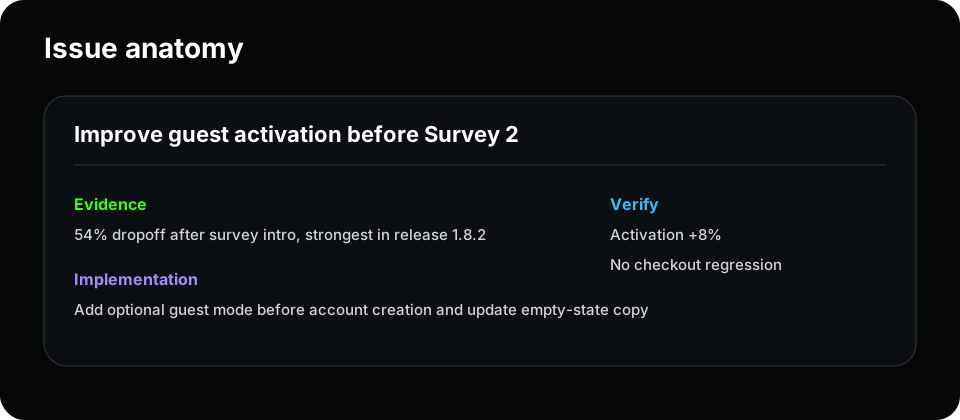
Here is the shape:
## Observation
Activation drops after Survey 2 in release data.

## Evidence
- 54% drop after Survey 2 over the last 14 days
- no matching Sentry crash spike
- feedback mentions setup fatigue
- trial starts are flat despite higher onboarding starts

## Recommended change
Add an optional guest path before account creation and shorten the survey copy.

## Likely surfaces
- app/onboarding/survey.tsx
- app/onboarding/account-step.tsx
- app/paywall/entry.tsx

## Verify
- onboarding completion +8%
- trial starts do not regress
- no increase in support complaints
This format gives Codex, OpenClaw, Claude Code, Cursor, or another coding agent enough context to work with.
What AnalyticsCLI Adds
AnalyticsCLI helps by making product data queryable from agent workflows.
Instead of manually copying dashboard screenshots, the agent can use bounded queries to inspect:
- funnels
- retention
- event breakdowns
- release/debug separation
- CSV exports when needed
- related signal summaries
When connected with GitHub context, the AI Growth Engineer can move from “what happened?” to “where should we look in the code?”
See the GitHub integration for the broader workflow.
Keep PR Creation Behind Review
Automatic issue creation is lower risk than automatic PR merging.
A good workflow is:
- Generate an issue from production evidence.
- Review the issue.
- Let the coding agent draft an implementation plan.
- Review the plan.
- Let the agent open a PR if the scope is clear.
- Review and test before merge.
- Verify the metric after release.
This is slower than blind automation, but much safer. Product work often has context that is not visible in analytics: brand, legal, customer commitments, pricing strategy, or roadmap timing.
What To Avoid
Avoid issues like:
Improve conversion.
That is not a task. It is a wish.
Also avoid:
- bundling unrelated improvements
- hiding uncertainty
- asking the agent to redesign a whole flow
- using only one metric without checking counter-metrics
- creating PR tasks without a verification plan
The point of production data is not to remove ambiguity. It is to make ambiguity explicit.
A Better Weekly Ritual
Once a week, run a focused review:
- Which funnel changed most?
- Which change is connected to revenue, retention, or feedback?
- Is there a crash or performance explanation?
- Is the fix likely to be small?
- Can we verify it in one release?
If the answer is yes, create an issue.
The product analytics for coding agents page explains how this fits into the larger AnalyticsCLI workflow.
FAQ
Should every analytics finding become an issue?
No. Only create issues when the evidence points to a specific product surface and a measurable change.
Can the AI Growth Engineer create PR tasks?
Yes, when configured. The safer default is to generate a reviewable issue or implementation handoff first.
What makes a good verification metric?
Use the smallest metric connected to the change, plus one counter-metric to catch regressions.